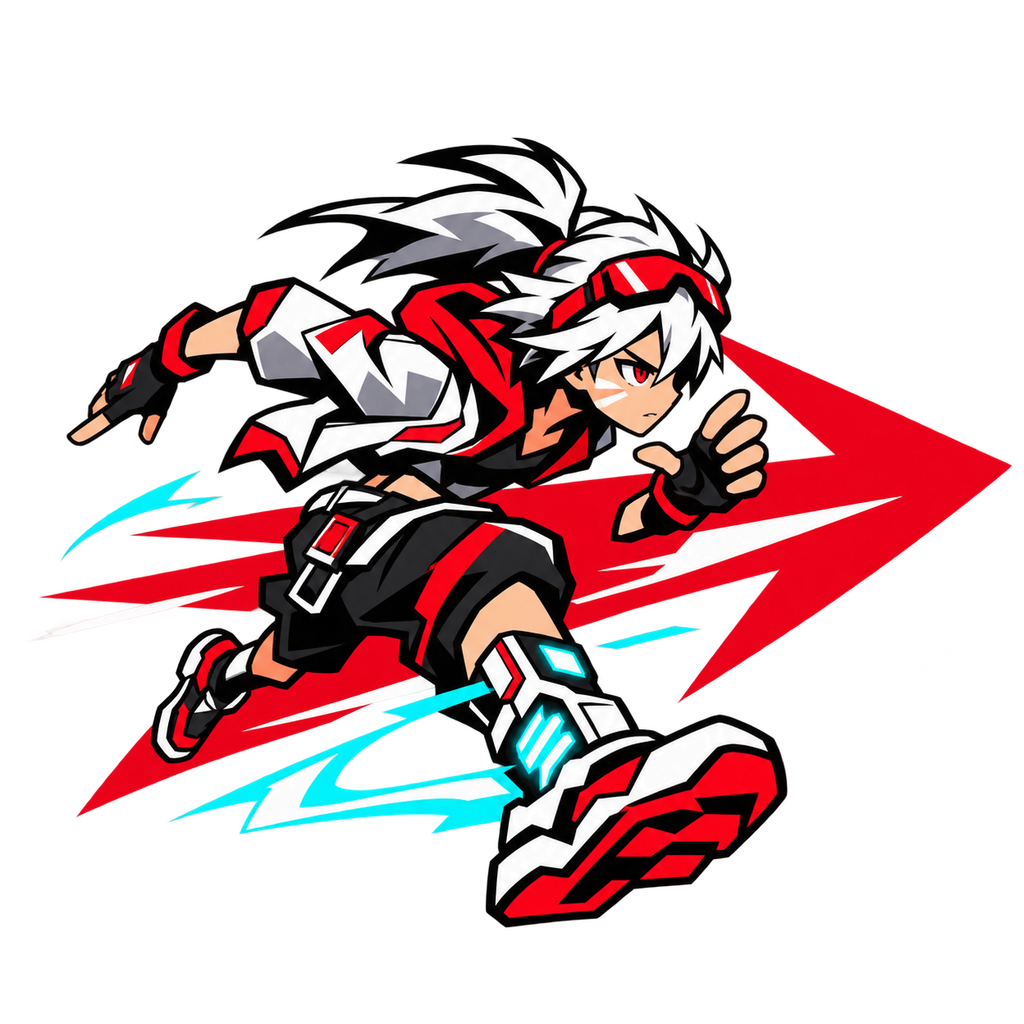
Boost Vector EX Advanced Movement Guide: Master Slides, Wall-Rides, and Charge Jumps
A Boost Vector EX advanced movement guide covering slides, charge jumps, side-strafes, wall-rides, and how to keep momentum on every course.
Speed is the entire sales pitch of Boost Vector EX, and the difference between a clean run and a messy one usually comes down to movement. This Boost Vector EX advanced movement guide breaks down the moves Blockage actually documents, how they chain together, and how to read each course so your racing line stays intact. If you have been sprinting into walls or dumping momentum at every corner, the fixes below matter more than any single trick.
The core design rule behind this Boost Vector EX advanced movement guide is simple: nothing should kill your momentum. Blockage shipped a high-speed parkour racer on November 2, 2026, and the official store text describes a sport built on stylish racing, handcrafted maps, and racers who each carry their own boost and style. Movement is the product. Everything else supports it.
The Documented Move List and What Each Move Does
The Steam listing is the most reliable source for what the game actually asks you to do. It names a specific set of movement examples rather than a vague "parkour" promise. Treat that list as your foundation before you chase shortcuts.
| Move | Documented role | Practical use |
|---|---|---|
| Slide | Listed official move example | Keeps you low and moving instead of stopping |
| Charge jump | Listed official move example | Builds height while preserving forward speed |
| Side-strafe | Listed official move example | Shifts your line without a full turn |
| Wall-ride | Listed official move example | Traverses vertical surfaces instead of dropping off |
| Tricks | Listed official move example | Style and expression during a run |
| Boost to leave | Listed official move example | Exits a situation with speed rather than a reset |
A few honest caveats. The store text does not publish frame data, input timings, or stamina costs for any of these moves. It also does not state that every move is available on every course. What it does say is that each Vector Master carries a personal boost and a personal style that "change movement in every way" and can decide a race. That means your move feel is character-dependent, not universal.
If you want to see the live feature list and the current store presentation for yourself, the official Boost Vector EX Steam page is the authoritative place to check. Prices and media there shift, so read them as a snapshot rather than a permanent spec sheet.
Chaining Moves Without Losing Speed
The momentum principle
Blockage's own framing, paraphrased, is that nothing should kill your momentum. That single sentence is the best coaching cue in the reference material. Every advanced movement decision should be judged by one question: did I keep moving forward, or did I stop?
That reframes how you practice. Instead of drilling one move in isolation, chain two and watch whether your speed survives the transition. A slide that ends in a dead stop is worse than a slide you never started.
Reading a course before you commit
The store description names three environmental directions: vertical beaches, descents along giant skyscrapers, and unreal dreamscapes. Each implies a different movement priority.
| Setting type | Source | Movement implication |
|---|---|---|
| Vertical beaches | Store description | Climbing and dropping; expect height changes |
| Skyscraper sides | Store description | Long vertical city runs rather than flat circuits |
| Dreamscapes | Store description | Unreal, dreamlike layouts that break expectation |
Because the maps are described as handcrafted and each one as unique, a route that works on one course will not transfer cleanly to another. A full map count is not officially documented, so plan to learn each course on its own terms rather than assuming a template.
Using your Master's boost as a chain tool
Since each Vector Master has a personal boost and style, your boost is not just a burst of speed — it is a movement modifier. The documented example is a "boost to leave," which suggests the boost is designed as an exit tool. Try treating it as the move that closes a chain: slide, charge jump, strafe, then boost out. The store does not describe exact boost behavior per character, so test your own Master and note what changes.
Course-Specific Notes From the Early Hotfixes
Hotfix 1.06, posted November 4, 2026, is not a movement guide, but it is the only official document that names specific courses. Three labels appear inside bug fixes, and each one tells you something about how that course reads in motion.
| Course label | What the hotfix addressed | Movement takeaway |
|---|---|---|
| Big Blue | An unusual wall-run collider was adjusted; some fallout points were fixed | Wall-rides here were the trouble spot; expect the surface to behave more consistently now |
| B Stadium | A checkpoint could leave you stuck | A frozen run was possible at a checkpoint; re-learn the approach |
| Homeline | A bad spawn could trap you | Spawn position could pin you; check your start before blaming your line |
The Big Blue entry is the most useful for an advanced player. A wall-run collider being "unusual" and then adjusted suggests wall-riding on that course was not behaving as intended. If you bounced off a wall in a way that felt wrong before the patch, that was likely the bug rather than your input.
One caution on course names: Hearth appears in a public video title — "Night Runner Top - Hearth 2:26.259 Major Skips | Boost Vector EX" — but not in the store text or the hotfix notes. Treat Hearth as community naming, and do not treat that 2:26.259 as a verified world record. No transcript or video URL was included in the source notes, so the route and shortcuts are undocumented. Global leaderboards are an official feature, which makes community times part of the culture, but a video title is not a leaderboard screenshot.
Fixing the Presentation Problems That Break Your Read
You cannot chain movement you cannot see. Two early issues directly affect whether a course reads clearly at speed, and both were addressed in the opening days.
On November 3, 2026, Blockage posted a note aimed at Mac players saying races should no longer look blown out, white, or glitchy. An edit acknowledged that a small group of Mac players still saw the problem. The documented temporary workaround is to set graphics to low from the main menu — and the developer noted the change will not take effect the same way during a race or tutorial. Set it on the menu, then enter the event.
Hotfix 1.06 also targeted a potential crash when shaders failed to load, and attempted another Mac fix that the developer said might or might not work while asking for reports. Neither of these is a new art direction; they are rendering repairs.
| Issue | Documented fix | Status per the notes |
|---|---|---|
| Mac image blown out, white, or glitchy | Set graphics to low on the main menu | Temporary workaround; some players still affected after the first fix |
| Shader load crash | Targeted in Hotfix 1.06 | Addressed in that patch |
| Big Blue wall-run collider | Adjusted in Hotfix 1.06 | Collision cleanup |
| B Stadium checkpoint stuck spot | Fixed in Hotfix 1.06 | Removes a run-freezing spot |
| Homeline bad spawn | Fixed in Hotfix 1.06 | Removes a trapping spawn |
If a course surface never loads, your timing cues vanish. A white, glitchy frame is a failed image even when the geometry underneath is fine. Clean rendering and clean collision are prerequisites for advanced movement, not luxuries.
Building a Practice Routine That Actually Transfers
There is no officially documented training mode, drill list, or timing benchmark in the reference material. What you can do is build a routine around the documented features and the documented moves.
| Store feature | How to use it for movement practice |
|---|---|
| Adjustable difficulty | Soften the debut sport while you learn a course's lines |
| Camera Comfort | A labeled option if high-speed cameras bother you |
| Playable without timed input | Useful if strict reaction windows are a barrier |
| Steam Cloud and leaderboards | Keep progress and compare times once you know a course |
| Cross-platform multiplayer, online PvP, online co-op | Play across the listed PC platforms |
A practical loop that stays inside documented ground:
- Pick one course and run it without chasing a time. Note where your momentum dies.
- Isolate the move at that spot — a slide, a charge jump, a strafe, or a wall-ride — and repeat the transition only.
- Add the boost as the chain's exit once the transition holds.
- Only then compare your time against the leaderboard, and only on that course.
- Label any community clip you learn from as player experience, not official guidance.
The store copy even jokes, in a playful tone, that strong lobbies will try shortcuts most racers will not touch. That is an invitation to experiment, not a published shortcut list. Major-skip footage exists in community titles, but the routes are not documented in official text.
FAQ
What moves does this Boost Vector EX advanced movement guide cover?
It covers the moves Blockage lists officially: slide, charge jump, side-strafe, wall-ride, tricks, and a boost to leave. Exact input timings and frame data are not officially documented, so treat the move list as the foundation and test the feel of each move with your own Vector Master.
Which courses should I practice advanced movement on?
Big Blue, B Stadium, and Homeline are the only course labels named in official patch notes, and each had a movement-relevant fix in Hotfix 1.06. The store also names vertical beaches, skyscraper sides, and dreamscapes as setting types. A complete course list is not officially documented.
Does my Vector Master change how movement feels?
The store text says each Vector Master has a personal boost and a personal style that change movement in every way and can decide a race. That means your boost behavior is character-dependent. No roster sheet or stat breakdown is officially documented, so compare Masters by feel.
Is the Mac graphics workaround part of this Boost Vector EX advanced movement guide?
It is a related fix, not a movement technique. If races look blown out, white, or glitchy on Mac, set graphics to low from the main menu before starting the event. The developer noted the change will not take effect the same way during a race or tutorial, and Hotfix 1.06 attempted another Mac fix that might not work for everyone.